Beyond Classical Limits: The Rise of Quantum Technologies


In his paper “The Main Areas of Quantum Technologies”, Carlos J. Costa provides a structured overview of the four foundational domains shaping today’s quantum technology landscape: quantum computing, quantum communication, quantum sensing and metrology, and quantum simulation. Costa explains how each area leverages core quantum principles—such as superposition, entanglement, and coherence—to achieve capabilities that surpass classical technologies.

The paper outlines the key physical platforms, applications, and technological maturity of each domain. Quantum computing is presented as a rapidly advancing research field with early industrial adoption through NISQ devices. Quantum communication, particularly through Quantum Key Distribution (QKD), is highlighted as one of the most commercially mature quantum technologies. Quantum sensing and metrology emerge as the most established area, with devices like atomic clocks and magnetometers already widely deployed. Quantum simulation is described as a powerful research tool for studying complex quantum systems, with growing overlap with quantum computing.

Costa concludes that quantum technologies represent a transformative paradigm with significant scientific, economic, and strategic implications. By organizing the field into four clear domains, the paper offers a coherent framework for understanding current progress and future directions in quantum innovation.


Costa, C. J. (2025). The Main Areas of Quantum Technologies. OAE – Organizational Architect and Engineer Journal. https://doi.org/10.21428/b3658bca.b4831fb6

Enhancing Tourist Experience in Lisbon with Gamification Strategies

In his study Carlos J. Costa investigates the integration of gamification strategies into Lisbon’s tourism sector to enhance visitor engagement, experience, and satisfaction. Lisbon can strengthen its position as an innovative and dynamic destination by incorporating game design elements- including challenges, rewards, storytelling, and progression systems into tourist activities. The research examines current trends, analyzes international best practices, proposes gamified experiences tailored to Lisbon’s unique cultural assets, and evaluates this approach’s potential benefits and implementation challenges.

Costa, C. J. (2025). Gamification in Lisbon Tourism: Enhancing Visitor Engagement Through Interactive Experiences. OAE – Organizational Architect and Engineer Journal. https://doi.org/10.21428/b3658bca.21946537

How Machine Learning Transforms Data into Insights


Machine Learning (ML) is a branch of artificial intelligence that focuses on enabling computers to learn from data and improve their performance on a task without being explicitly programmed for every step. Instead of writing detailed instructions to solve a problem, we give the computer access to data and let it discover the patterns independently. This approach has become fundamental in many areas — from personalized recommendations on movie attendance or hotel choices to fraud detection in banking and medical diagnostics.


Costa, C. J. (2025). Introduction to Machine Learning. OAE – Organizational Architect and Engineer Journal. https://doi.org/10.21428/b3658bca.35c216ce

Integrating LLM Usage in Gamified Systems

In his work, Prof. Carlos Costa uses a mathematical framework for formalize an approach that allows incorporating Large Language Models (LLMs) into gamified systems is presented with an emphasis on improving task dynamics increasing user engagement, and improving reward systems.

Personalized feedback adaptive learning and dynamic content creation are all made possible by the integration of LLMs and are crucial for improving user engagement and system performance. Carlos uses a simulated environment to test the framework’s adaptability and demonstrate its potential for real-world applications in a variety of industries including business healthcare and education. According to Dr. Costa, his findings demonstrate how LLMs can offer customized experiences that raise system effectiveness and user retention. His study also examines the difficulties this framework aims to solve highlighting its importance in maximizing involvement and encouraging sustained behavioral change in a range of sectors.

Costa, Carlos J. 2025. “Integrating LLM Usage in Gamified Systems.” WSEAS Transactions on Mathematics 24:258–67. doi: 10.37394/23206.2025.24.25.

Scenario Generation

In their last paper,  Joao Tiago Aparicio and Carlos Costa explore artificial intelligence’s potential societal and economic impacts (AI) through generating scenarios that assess how AI may influence various sectors. They categorize and analyze key factors affecting AI’s integration and adoption by applying an Impact-Uncertainty Matrix. A proposed methodology involves querying academic databases, identifying emerging trends and topics, and categorizing these into an impact uncertainty framework. The paper identifies critical areas where AI may bring significant change and outlines potential future scenarios based on these insights. This research aims to inform policymakers, industry leaders, and researchers on the strategic planning required to address the challenges and opportunities AI presents.

Scenario creation process.

Costa, C. J., & Aparicio, J. T. (2025). Exploring the Societal and Economic Impacts of Artificial Intelligence: A Scenario Generation Methodology. arXiv preprint arXiv:2504.01992. DOI: https://doi.org/10.48550/arXiv.2504.01992

AI and Management

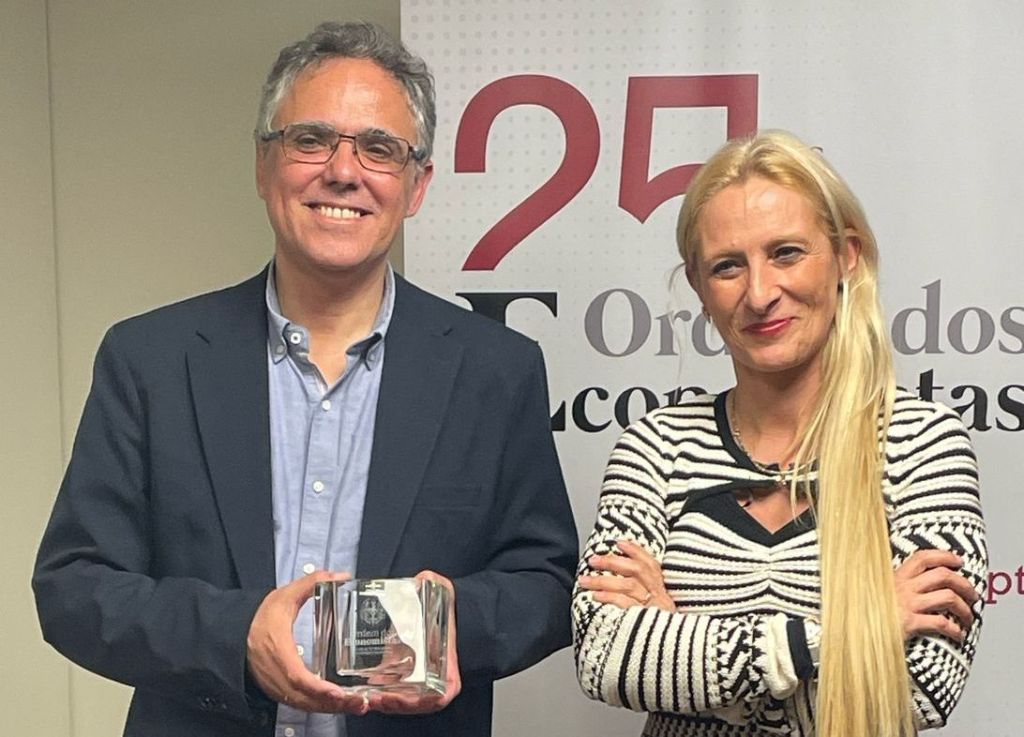
Prof. Carlos Costa delivered a lecture titled AI and Management at the Portuguese Association of Economists. In his talk, he discussed the history of AI and its impact on organizations. He also shared some of the findings from his research and that of his team.

Blockchain Adoption Factors: New Research Insights

A recent study conducted by researchers from Portuguese institutions examines blockchain adoption among small and medium-sized organizations (SMEs), with a focus on Trust and Security. The research, titled Blockchain Adoption Factors, explores the key drivers and challenges of implementing blockchain technology, which has the potential to impact various sectors, including finance and healthcare.

The research, led by Carlos Bernardino, Francisco Cesário, Carlos J. Costa, Manuela Aparicio, and João Tiago Aparicio, investigates the factors that influence blockchain adoption, focusing on Trust and Security as essential moderators in the decision-making process of SMEs. The study used a questionnaire distributed to employees from various industries, and analyzed the results through Structural Equation Modeling (SEM-PLS).

Continue reading “Blockchain Adoption Factors: New Research Insights”

The Rise of DeFi: Revolutionizing Finance Through Decentralization

The financial world is undergoing a seismic shift with the emergence of Decentralized Finance, or DeFi. This groundbreaking movement leverages blockchain technology to create an open, transparent, and decentralized ecosystem, aiming to redefine traditional financial systems. A recent study by Carlos J. Costa, titled DeFi: Concepts and Ecosystem (2024), provides a comprehensive exploration of this phenomenon, highlighting its transformative potential, risks, and opportunities.

DeFi refers to a collection of financial services, such as lending, borrowing, trading, and investing, facilitated by blockchain networks instead of traditional financial institutions. Unlike centralized banks or brokers, DeFi platforms operate on smart contracts—self-executing agreements encoded on blockchain technology. These platforms enable peer-to-peer transactions, enhancing financial inclusion and reducing reliance on intermediaries..

Carlos J. Costa’s study provides an in-depth exploration of the rapidly evolving DeFi landscape, using bibliometric and thematic analyses to uncover critical insights about its concepts, trends, opportunities, risks, and participants.

Continue reading “The Rise of DeFi: Revolutionizing Finance Through Decentralization”